




Your refrigerator stopped working. Maybe the food inside is warm, or it made a strange sound last night, and now it’s completely quiet. You’re standing in the kitchen trying to figure out whether to call a repair technician or drive to the appliance store — and you’re not sure which decision will cost you more: Refrigerator Repair vs. Replacement.
That uncertainty is completely normal. Refrigerators are among the few appliances in which service and purchase costs can genuinely overlap, making the decision harder than it sounds. The good news is that a few clear factors — the age of your fridge, the type of problem it has, and the actual cost of fixing it — almost always point toward the right answer. This guide walks you through each option so you can make a confident, financially smart decision about whether to repair or replace a refrigerator!
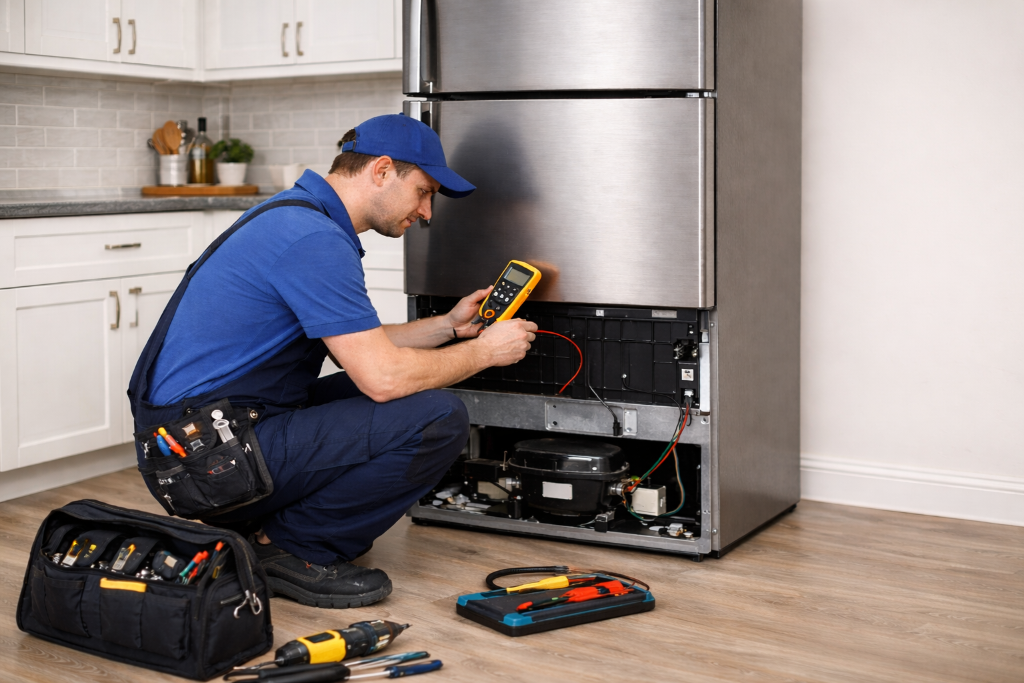
Table of Contents -Refrigerator Repair vs. Replacement
How Old Is Your Refrigerator? Age Changes Everything
Before you call anyone or look up prices on a new unit, check when your refrigerator was manufactured. You’ll usually find a sticker inside the door frame or on the back of the unit with a serial number — most manufacturers encode the production date in that number, or you can look it up on their website by model.
Age matters because it changes the math on every repair. A well-maintained refrigerator has an expected lifespan of roughly 10 to 20 years, with most units averaging around 13 to 15 years, depending on the brand and configuration. Top-freezer models tend to run the longest. Side-by-side units have shorter average lifespans, and French door models fall somewhere in between.
If your refrigerator is under eight years old, repair is almost always the right call — unless the damage is catastrophic. You still have the majority of the appliance’s useful life ahead of you, and most fixes will cost a fraction of what a new unit would. Between eight and fifteen years, the type and cost of the repair become the deciding factor, and you’ll want to use the framework below before committing. Beyond fifteen years, especially if this isn’t the first repair, buying new starts to make real sense.
That said, age is a starting point, not a verdict. A 12-year-old Whirlpool or Maytag that’s been well maintained and has a straightforward problem is often still worth fixing. Context matters, and that’s exactly why a professional diagnosis is so valuable before you make any decision.
The 50% Rule: Key Factors the Industry Relies On
The most reliable guideline in the appliance industry is the 50% Rule: if the repair cost exceeds 50% of what a comparable new refrigerator would cost, a new purchase is the smarter investment.
Here’s how it works in practice. If a new refrigerator similar to yours costs $1,200 and the estimate comes in at $700, you’re past the threshold — and spending that much on a malfunctioning refrigerator is hard to justify. If the fix runs $350, you’re well under the line, and addressing it is almost certainly the better financial move.
The rule gets more nuanced when you layer age on top of it. A repair that’s 45% of the replacement cost is an easy yes on a six-year-old refrigerator. On a fourteen-year-old unit, that same repair deserves a harder look. You’re not just paying for the fix — you’re betting that the appliance has enough remaining life to make the investment worthwhile.
Before you do any math, check whether your refrigerator is still under a manufacturer’s warranty or an extended service plan. If it is, some or all of the cost may already be covered, which changes the calculation entirely. It’s worth a five-minute check before you spend anything. Should You Repair or Replace Your Broken Refrigerator?
In a survey, 27 percent of consumers who discarded their refrigerator cited expensive repair costs as their reason for not repairing it.

Repairs That Are Almost Always Worth the Investment
Most refrigerator problems — the ones that feel alarming — turn out to be relatively minor. A fridge that’s running warm doesn’t necessarily have a failed compressor. An ice maker that stopped working is rarely a reason to swap out the whole appliance. Many of the most common failures are straightforward to diagnose and affordable to fix, typically running between $100 and $300.
Thermostat and temperature control failures are a good example. If your refrigerator isn’t holding the right temperature but the compressor is working fine, the fix is usually a sensor or control board issue — far less dramatic than it sounds. The same goes for ice maker problems, whether that’s no ice production, leaking, or small misshapen cubes. Water dispenser issues — clogged lines, faulty inlet valves, or a broken switch — fall into the same category.
Door seal replacement is another fix that’s easy to overlook and inexpensive. Worn or cracked gaskets let warm air into the refrigerator compartment, forcing the compressor to work harder and driving up your energy bill. Replacing the seals is a relatively small expense that can make a meaningful difference in the unit’s efficiency. Evaporator and condenser fan failures, clogged defrost drains, and start relay replacements are all in the same category — common, affordable, and well worth addressing rather than walking away from an otherwise healthy appliance.
When the Math Points Toward a New Fridge
Some problems tell a different story. Compressor failure is the one that most dramatically changes the equation. The compressor is the core of your refrigerator’s cooling system, and replacing it is the most expensive fix you’re likely to face — typically $300 to $600 or more, depending on the brand and model. On a newer refrigerator, that expense is often still justified. On an old fridge whose compressor has failed, the 50% Rule will almost always point you toward buying new.
Sealed system failures — refrigerant leaks, evaporator coil damage, or problems with the condenser — fall into the same territory. These jobs require certified technicians with specialized equipment, and the labor alone can push the cost into the range where a new unit makes more sense. What initially appears to be a single refrigerant leak often involves multiple components once a technician opens the system, which is why sealed-system work is difficult to estimate without a proper diagnosis.
Multiple simultaneous failures are another signal that the appliance may have run its course. If the compressor is struggling, the ice maker has stopped working, and the door seals need replacing all at once, you’re looking at a compounding bill on an appliance that’s telling you it’s worn out. At that point, putting significant money into it is rarely the right call.
The Energy Efficiency Question
It’s worth factoring in your electricity bill when making this decision, especially if your refrigerator is more than ten years old. Older models are significantly less energy-efficient than those available today — refrigerators made before 2010 can cost $100 to $200 per year to run, while a current Energy Star-certified, energy-efficient appliance typically costs $50 to $70 annually. Over ten years, that gap can amount to $1,000 or more. That’s one of the clearest benefits of upgrading when an older unit is already near the end of its useful life.
Modern ENERGY STAR refrigerators use up to 40% less power than models from 10-15 years ago, significantly reducing energy consumption.
That said, the true cost of a new refrigerator goes beyond the sticker price. Delivery, haul-away of the old unit, installation, and the food you’ll lose during the transition are all real expenses. A fix that extends your refrigerator’s life by four or five years is often still the smarter financial move, even accounting for moderately higher energy use. The energy-efficiency argument is worth knowing, but it rarely tips the scales on its own — it’s just one data point in a broader picture.
Why You Should Get a Professional Diagnosis Before Deciding on a New Appliance
One of the most common and costly mistakes homeowners make is replacing a refrigerator that could have been fixed for a couple of hundred dollars. The inverse happens too — money goes into parts and DIY work that doesn’t address the actual problem, and the appliance ends up being replaced anyway. A professional diagnosis eliminates both risks.
A qualified technician can tell you exactly what’s wrong, what it will cost to fix, and offer expert advice based on the age and condition of your specific appliance. Refrigerator internals are not particularly DIY-friendly — the components can be difficult to access safely, and misdiagnosis can escalate a minor fix into a major one. Getting a professional in to assess the situation first almost always saves money, regardless of the decision’s direction.
When you do call for service, ask the technician to walk you through the 50% Rule calculation with their estimate in hand. A good technician will do this without prompting, and if the expensive repair doesn’t make financial sense for your specific appliance, they’ll tell you so directly.

Emporium Appliance Repair: Aurora’s Refrigerator Repair Specialists
We have been the go-to choice for appliance repair in Aurora and the surrounding Denver metro area since 2008, including fast, affordable Aurora freezer repair services. We’re factory authorized, which means our technicians are trained and certified on the brands most households rely on — Whirlpool, Kenmore, Frigidaire, Samsung, LG, GE, Electrolux, Maytag, KitchenAid, and Amana, among others.
Every repair we perform uses genuine manufacturer-approved parts, not generic alternatives. That distinction matters more than most people realize. Off-brand components are often built to looser tolerances than the original parts they replace, which means they tend to fail sooner and can sometimes cause additional damage in the process. Genuine parts fit correctly, carry manufacturer warranties, and perform as your appliance was designed to. Combined with our labor guarantee, every repair we complete is fully backed.
We offer same-day and next-day appointments, provide a clear upfront estimate before any work begins, and never charge hidden fees. If you’re weighing whether to fix or replace your refrigerator, the first step is a diagnosis — and we make that easy, and our team can also help with Aurora garbage disposal repair and maintenance to keep your kitchen running smoothly.
Call us at 303-369-8888 or schedule your service appointment online. We’re ready to help you make the right call.
Frequently Asked Questions–Refrigerator Repair vs. Replacement
How long should a refrigerator last?
Most refrigerators last between 10 and 20 years, with an average lifespan of around 13 to 15 years. Top-freezer models tend to outlast side-by-side and French door units. Regular maintenance — cleaning condenser coils, checking door seals, and catching small problems early — can push that lifespan toward the higher end of the range. High-end built-in models, such as Sub-Zero, are designed to last 20+ years and often justify expensive repairs.
Is it worth repairing a 10-year-old refrigerator with major problems?
In most cases, yes — provided it is a common issue like a thermostat, fan motor, ice maker, or door seal. A 10-year-old refrigerator still has meaningful life ahead of it, and a fix in the $150–$300 range is almost always a sound investment. Compressor failure at that age is the exception; that’s where the 50% Rule and an honest technician’s assessment become especially important.
Is it cheaper to repair or replace a refrigerator?
For most common problems, repairing your existing refrigerator is significantly less expensive than buying a new one. A mid-range unit runs $900 to $1,800 after delivery and haul-away, plus any food lost during the transition. Most service calls fall well below that. That changes when costs approach 50% of an older appliance’s replacement value — which is exactly the scenario where a professional diagnosis and an honest estimate matter most.
What is the most expensive refrigerator repair?
Compressor replacement is typically the most expensive fix a refrigerator requires, generally ranging from $300 to $600 or more, depending on the brand and model. Sealed-system repairs involving refrigerant leaks or evaporator-coil damage can be similarly costly. These are the situations where the appliance’s age and the 50% Rule carry the most weight.
How much does refrigerator repair cost in Aurora, CO?
Costs vary depending on the problem. Minor fixes — thermostat replacement, door gaskets, drain line clearing — typically run $100 to $250. Mid-range work, such as ice maker replacement or fan motor issues, generally falls between $150 and $350. Major repairs can cost $300 to $600 or more. Emporium Appliance Repair provides upfront estimates before any work begins, with no hidden charges.
Does Emporium Appliance Repair offer same-day service?
Yes. Same-day and next-day appointments are available for appliance repair services throughout Aurora and the Denver metro area. Call 303-369-8888 or schedule online appliance repair service to book your appointment.