



When your refrigerator stops cooling on a hot afternoon in Aurora, every hour counts. If you’re asking why is my refrigerator not cooling in Aurora, CO, you’re not alone—food spoils quickly when internal temperatures rise above 40°F, and summer days on the Front Range can push kitchen temperatures well into the 80s or 90s. The good news: most cooling problems stem from addressable causes you can check yourself before calling for service.
Table of Contents – Refrigerator Not Cooling
Quick answers for Aurora homeowners
Most refrigerator not-cooling issues trace back to four common culprits: power problems, incorrect temperature settings, blocked airflow, and dirty condenser coils. Before assuming the worst, run through this quick checklist:
- Verify power to the outlet by testing it with a small lamp or phone charger
- Confirm the thermostat is set between 33°F–40°F (37°F is the standard target)
- Check that the refrigerator door closes completely and the seal feels tight
If these basics check out and your fridge still isn’t cooling properly after a few hours, professional appliance repair service in Aurora is usually the next logical step. Multiple local providers offer same-day or next-day appointments.
Typical refrigerator temperatures and what’s normal in Aurora
Aurora’s climate creates unique challenges for refrigeration. The city sits at approximately 5,280 feet elevation, experiences bone-dry winters, and regularly sees summer highs above 90°F. This 90+° temperature swing throughout the year means your refrigerator works substantially harder during the hot months.
Here’s what to target for safe food storage:
Compartment | Ideal Temperature | Notes |
|---|---|---|
Refrigerator section | 33°F–40°F | 37°F is the most common manufacturer default |
Freezer section | 0°F or below | -0.4°F is standard for optimal performance |
Don’t trust the built-in dial or control panel—these are often imprecise. Place a simple fridge thermometer on the center shelf and leave it for 24 hours to get an accurate reading.
In older Aurora homes, south-facing kitchen windows create afternoon heat loads that force the fridge to run longer cycles. This is normal operation, not failure. Kitchens with multiple exterior walls or outdated insulation experience greater temperature fluctuations, making the compressor work overtime.
Fast troubleshooting steps when your fridge stops cooling
Before scheduling a service call, work through these troubleshooting steps systematically.
Power verification:
- Confirm the fridge is plugged in (cords can get dislodged when cleaning)
- Test the outlet with another appliance
- Check your home’s circuit breaker for tripped switches
- Look for a popped GFCI outlet nearby—Aurora kitchens require GFCI protection within six feet of sinks
Temperature control check:
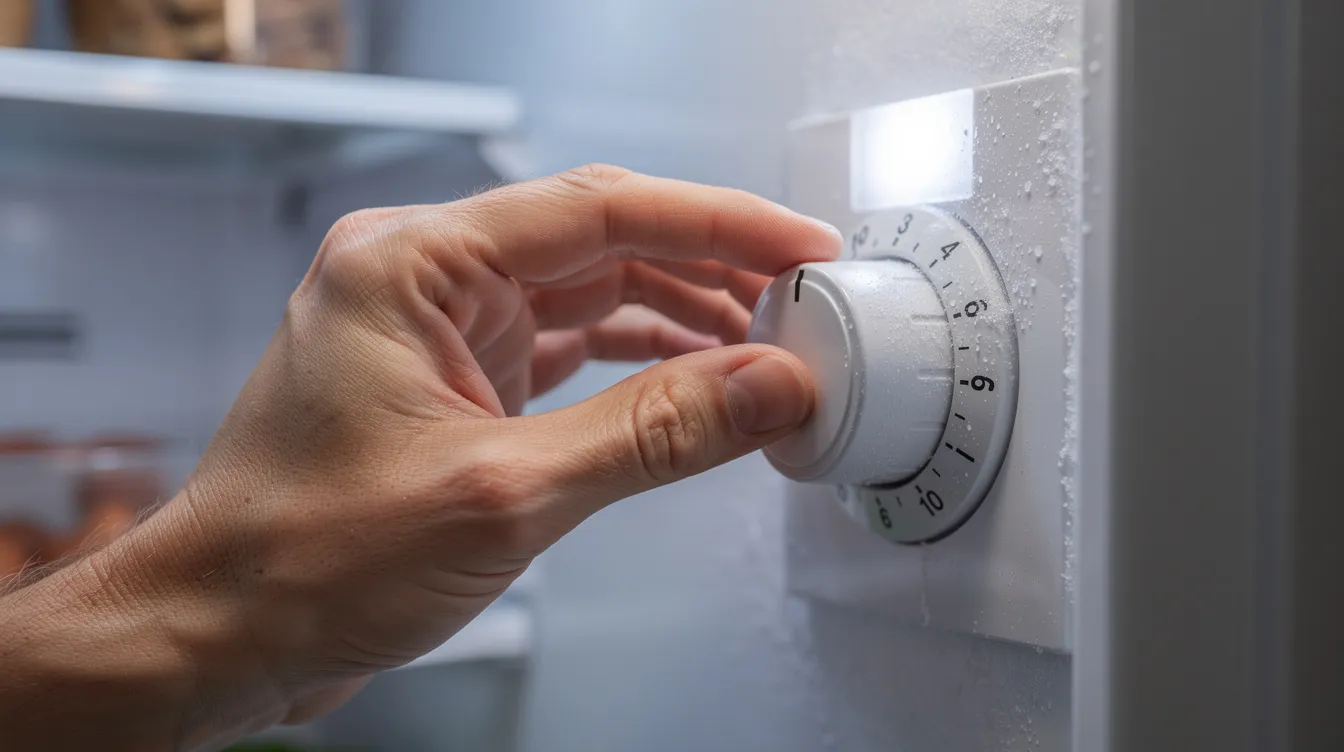
- Inspect the temperature controls—dials get bumped during cleaning or when loading groceries
- Adjust temperature settings to approximately 37°F for the fridge and 0°F for the freezer temp
- Wait 24 hours before making additional changes
If you’ve just returned from a grocery run on South Parker Road with bags of warm food items, the refrigerator needs time to recover. Loading many room-temperature items temporarily raises the internal temperature by 5–10°F. Give the compressor 4–8 hours to bring things back down.
Listen for clues: Is the refrigerator’s compressor humming and cycling (normal)? Is it running constantly without stopping (potential problem)? Is there no sound at all (power or component issue)?
Installation and location problems in Aurora kitchens
Many Aurora condos, townhomes, and homes built between 1990–2000 feature compact kitchen layouts with tight alcoves. When a refrigerator is pushed flush against the walls, warm air from the condenser coils has nowhere to escape.
Required clearances for proper heat dissipation:
- At least ½ inch on each side
- 1 inch or more behind the unit
- Enough clearance at the top for hot air to rise
Heat source proximity matters significantly. A fridge placed next to your range, oven, or dishwasher must work harder to maintain the right temperature. West-facing kitchen windows—common in Aurora—create afternoon solar heat loads that can raise kitchen temperatures 5–15°F above the rest of the home.
Garage refrigerators present another problem: Aurora garages can exceed 120°F in summer or drop below freezing in winter. Most refrigerators are designed for 50°F–110°F ambient temperatures. Outside this range, the appliance simply cannot function as designed.
Quick fixes:
- Carefully pull the unit a few inches from the wall
- Consider relocating from hot corners or direct sunlight
- Never place a new fridge in an unconditioned garage
Leveling and door alignment issues
If your fridge sits on an uneven floor—common in older Aurora homes with concrete slabs or warped vinyl flooring—the doors may not seal properly. Most models are designed to tilt slightly backward (2–3 degrees), so doors swing closed automatically.
Use a small bubble level on the top front edge to check alignment. If the unit tips forward or sits perfectly level, doors won’t seal correctly, letting cold air escape all day.
Adjust the front leveling legs according to your owner’s manual until doors close firmly without slamming. This simple fix resolves many “refrigerator returns to warm” complaints.
How food organization and blocked vents cause warm spots
Every fridge has air vents connecting the freezer and refrigerator compartments—typically on the back wall or ceiling. When you overstuff the unit after a big grocery trip, these vents get blocked, and cool air cannot circulate to where it’s needed.
Common mistakes that block air flow:
- Pizza boxes pressed against the back wall vents
- Large casserole dishes covering ceiling vents
- Bags of vegetables crammed into every available space
- Stacking items too high in the freezer
Keep at least 2 inches of clearance around all vents. Organize frequently used items toward the front to minimize door-open time—this matters more on hot Aurora summer days when each opening floods the interior with warm air.
Overloading and air circulation
Cold air needs room to move. When every shelf is packed tight, air continues to stagnate, and temperatures rise unevenly. You might find ice cubes freezing solid in the freezer while fresh food spoils on the fridge shelves.
Maintain open space along sides and above tall items for proper circulation. Top-freezer units common in Aurora apartments have limited air vents; blocking them affects both compartments.
Adding many warm meal-prep containers on a Sunday temporarily raises the interior temperature. Move easily spoiled items (meat, dairy) to the coldest areas while the compressor works to recover a stable temperature.
Dirty condenser coils and Aurora dust
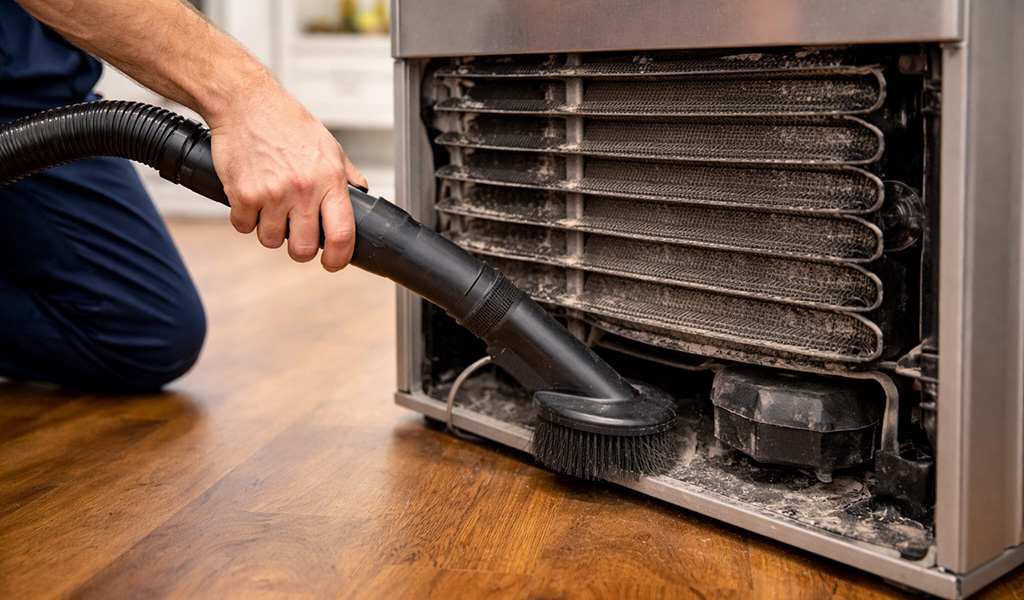
Aurora’s semi-arid climate—with humidity typically between 30–50%—creates rapid condenser coil contamination. Dust combines with pet hair, pollen, and construction particles from the Front Range’s ongoing development. This buildup acts as insulation, trapping heat and preventing efficient cooling.
Condenser coils are located either:
- Behind a pop-off lower front grille
- On the exterior back of the unit
Buildup appears as a gray or tan mat of dust and fibers coating thin metal fins. Severely clogged coils cause the fridge to run non-stop, feel warm on the sides, and never reach safe temperatures.
Safe cleaning routine:
- Unplug the refrigerator
- Remove the grille or access the back
- Use a vacuum cleaner with a brush attachment to gently remove buildup
- Avoid bending the thin aluminum fins
For typical Aurora households, clean coils every 6 months. Homes with pets or near construction sites should be cleaned every 3 months to maintain optimal performance.
Doors, gaskets, and warm kitchen air
The door seal (gasket) keeps Aurora’s warm, dry air out. When gaskets fail, the fridge struggles to maintain temperature even when everything else works perfectly.
How to check gasket condition:
- Look for visible tears, cracks, or corner separation
- Perform the paper test: insert a thin piece of paper between the gasket and cabinet, close the door, and try pulling it out
- If the paper slides out easily, the seal is compromised
Clean gaskets with warm, soapy water to remove dried spills and crumbs, which can prevent proper contact. Kids coming home from school, opening the freezer door repeatedly, or leaving doors ajar after stocking groceries can quickly raise internal temperatures—especially when combined with a marginal seal.
Replacement gaskets cost $75–$200 and are model-specific. Proper fit matters enough that many Aurora homeowners choose professional installation rather than attempting DIY.
Moisture, frost, and their effect on cooling
Even in Colorado’s dry climate, humid summer days and frequent door openings introduce moisture that freezes on evaporator coils or along door frames. Frost buildup and ice buildup block internal air passages, creating the frustrating scenario where the freezer works fine but the fridge stays warm.
Heavy frost in the freezer compartment—a thick white or crystalline coating—typically indicates the automatic defrost cycle is failing.
Frost buildup due to a failed defrost system hinders airflow by blocking the evaporator coils.
Manual defrost procedure:
- Unplug the unit
- Protect floors with towels
- Allow frost to melt over 4–12 hours
- Remove accumulated water
- Restart and monitor the temperature
If frost buildup recurs within weeks, this signals a defrost thermostat or defrost timer failure requiring professional diagnosis.
When the freezer is cold but the fridge is warm
This common Aurora complaint typically affects side-by-side and top-freezer models. Cold air is produced by the evaporator coils in the freezer and then distributed to the fridge through a damper door controlled by a thermostat.
When this pathway fails:
- The damper door sticks closed, blocking cool air from reaching fresh food
- The evap fan stops spinning due to ice buildup or motor failure
- The evaporator fan motor burns out, stopping air circulation entirely
You can listen for the evaporator fan (a faint humming behind the freezer’s rear panel) and look for obvious ice blockages. Check the door switch functionality—holding it closed should activate the fan.
However, accessing the fans and damper doors requires disassembly beyond the typical homeowner’s capability. A deeper diagnosis is better left to a technician who can properly inspect select models and their specific configurations.
Internal component failures that need a professional
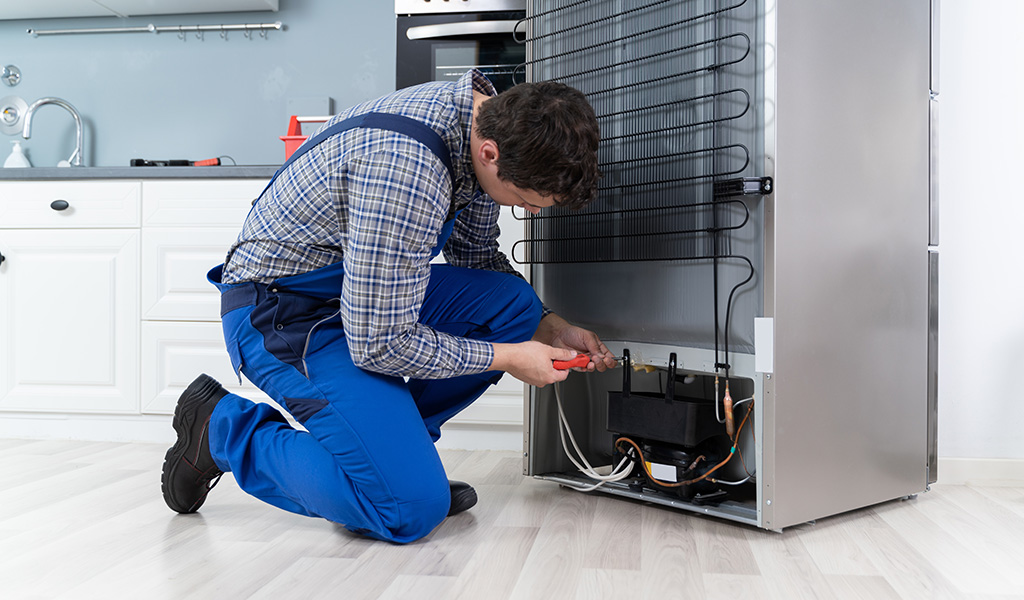
When basic troubleshooting doesn’t resolve your cooling issues, the problem likely involves internal components like the compressor, fans, or electronic controls.
Components that commonly fail:
- Evaporator fan motor
- Condenser fan motor
- Compressor and start relay
- Defrost heater
- Thermistors and temperature sensors
- Main control board
Warning symptoms:
- Loud buzzing or clicking from the compressor area
- Fans are not running when they should
- Constant running without cooling improvement
- Visible ice covering evaporator coils
- Burning smells (stop using immediately)
- Repeatedly tripping the circuit breaker
Handling sealed refrigerant systems requires EPA certification. High-voltage capacitors store dangerous electrical charges. These repairs demand specialized tools and training—not a DIY project.
Before calling, gather your model number (found on a label inside the unit), the appliance age, when the problem started, and descriptions of any unusual noises. This speeds diagnosis considerably.
Signs your compressor may be failing
A healthy compressor produces a steady, moderate hum that cycles on (10–20 minutes) and off (5–15 minutes) throughout the day. This cycling pattern is normal.
Warning signs of compressor failure:
- Repeated clicking without the motor starting
- Grinding or metallic noises from the compressor area
- Constant running with no temperature improvement
- Tripping the home’s circuit breaker when starting
Compressor replacement typically costs $400–$800 for parts, plus labor—often totaling $600–$1,200. For refrigerators manufactured more than 10–12 years ago, this cost may exceed 50% of replacement value, making a new fridge the smarter investment.
Never attempt refrigerant work yourself. It requires specialized equipment and EPA-certified handling.
When to call a local Aurora refrigerator repair expert
If your fridge still isn’t cooling after checking the power source, temperature settings, coils, air vents, and the door seal, professional service is the logical next step.
Call a technician immediately when: (Refrigerator Not Cooling)
- Food is spoiling despite the correct thermostat settings
- Internal temperature stays above 40°F for more than 24 hours
- You hear persistent loud or grinding noises
- You detect burning smells
- The breaker trips repeatedly when the compressor runs
- The ice maker stops working alongside cooling problems
- The unit enters diagnostic mode unexpectedly
Aurora residents can typically expect same-day or next-day appointments, on-site diagnosis, and clear cost estimates before any repair begins. Most refrigerator cooling problems—roughly 70–80% of cases—are resolved without replacing the entire appliance, particularly when addressed within the first 24 hours.
When home troubleshooting isn’t enough, contact Appliance Repair Emporium at 3102 S Parker Rd A2, Aurora, CO 80014, or call 303-369-8888 for professional diagnosis and repair.
FAQ’s – Why Is My Refrigerator Not Cooling in Aurora, CO?
What is the recommended temperature for my refrigerator?
The ideal temperature range is 33°F–40°F, with 37°F as the most common target. Your freezer should maintain 0°F or slightly below. Use an actual thermometer rather than relying on the set temperature displayed on dials.
How often should I clean my refrigerator’s condenser coils?
Every 6 months in typical Aurora households. If you have pets or live near construction, increase frequency to every 3 months. A dirty condenser is one of the top reasons a refrigerator stops cooling properly.
Why is my freezer cold but my fridge section warm?
This usually indicates a blocked damper door or a failed evaporator fan motor. Cold air is produced in the freezer and shared with the fridge compartment. When this pathway is interrupted, the fridge warms while the freezer stays cold.
Can I fix refrigerant problems myself?
No. Refrigerant systems contain pressurized gases requiring EPA certification to handle legally and safely. The compressor also contains high-voltage capacitors that can cause serious injury. Always hire a certified technician for sealed-system repair.
How much does refrigerator repair typically cost in Aurora?
Diagnosis runs $85–$150, with repairs ranging from $200–$1,200+, depending on the component. Simple fixes like replacing a door seal cost less; compressor replacement sits at the higher end. For units older than 10–12 years, weigh repair costs against replacement value.
Is sealing properly important for cooling?
Absolutely. A compromised door seal allows warm kitchen air to continually infiltrate, forcing the compressor to run continuously and fail to maintain proper temperature. Test your seal with the paper method and clean or replace gaskets as needed.